BREAKFLOWAnalog Smart Contract
A livestreamed machine that sells the €1 destruction of consumer-object replicas, and makes its own losing economy public in real time.
Key facts
Description
BreakFlow is a self-evolving infrastructure. Each participation triggers a blow on a fragment of the real and turns it into a bundle of traces: debt, data, images, archived debris. The system grows from its activation by the public, but if no one strikes, the machine strikes on its own, mechanically increasing its own debt.
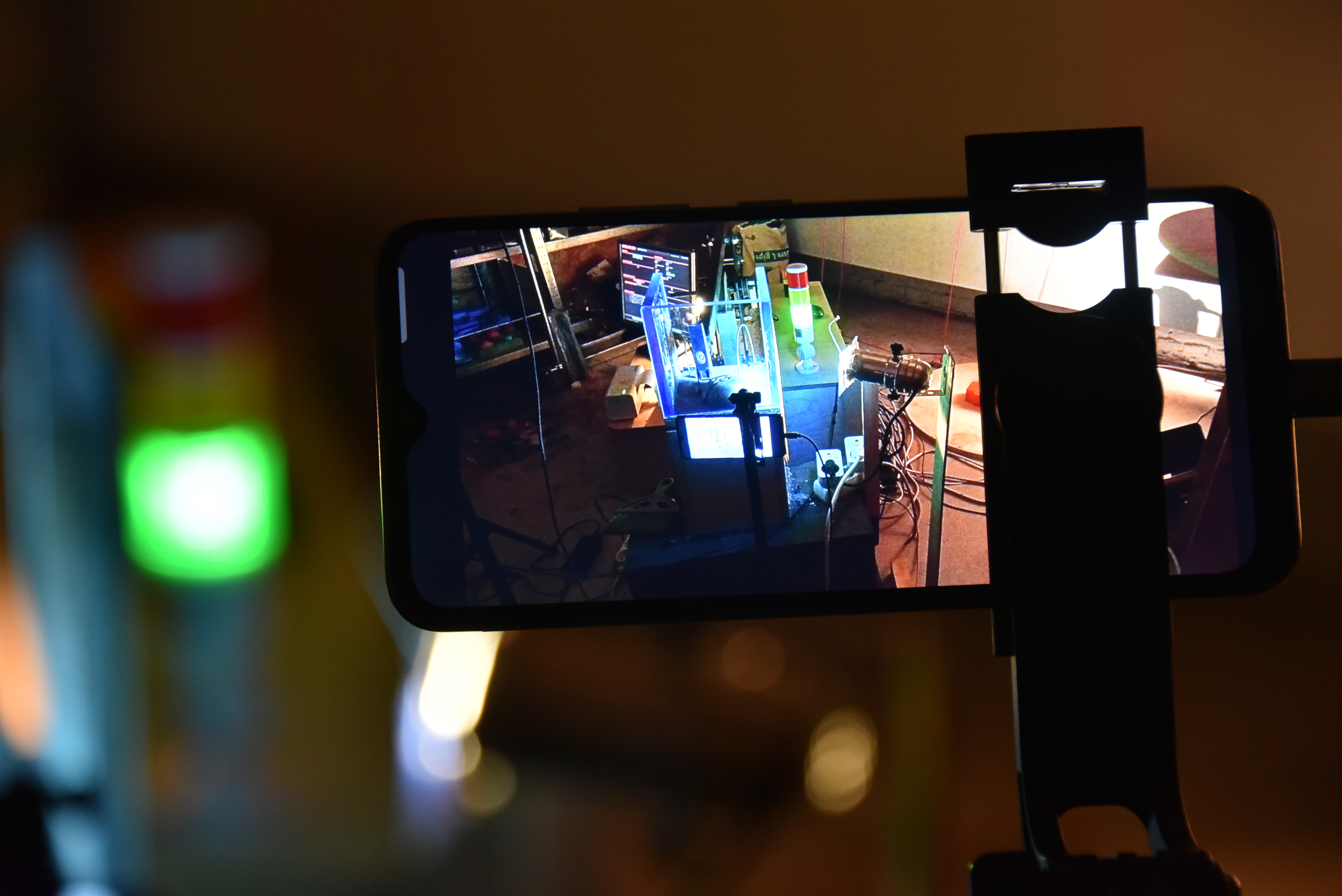
BreakFlow takes the form of a website connected to a machine. A website whose clicks have irreversible physical consequences: an online work that acts on the real. You pay 1 € to trigger, live, the irreversible destruction of a plaster cast, the negative of everyday packaging. In real time the site shows the blows, the intensity (the more the system is used, the more blows it takes to destroy a fragment: the machine resists its own success), the loss, the register of participants, the archived debris...
What is struck are not neutral blocks: plaster casts of thermoformed packaging, ghosts of our consumer objects, toys, food, electronics. The selected debris is bagged, labelled with the participants' names, and kept. Each fragment becomes a recording surface, the material trace of those who activated the machine. The leftover scrap is recast into new fragments, ready to be destroyed: the matter runs in a loop.
The device works as an analog smart contract: a payment automatically triggers an irreversible physical execution, recorded at once in the database, the video and the matter, with no blockchain.
The installation runs in live sessions, broadcast exclusively on the website. Anyone can trigger a blow for one euro. Each session is a different proposition: all proceeds are reinvested in the machine, which evolves at the rhythm of participation. Each session aims at a critical mass, a threshold of fragments set before the session. Reaching it triggers the finale: a secondary mechanism releases, a weight drops and opens a latch that lets a weighted spike fall onto a larger fragment. The finale ends the session; otherwise it runs until the scheduled end time.
I start from a trivial, often absurd element, and surround it with an apparatus so organized and proliferating that it becomes disproportionate. Everything plays out in that gap between the smallness of the starting point and the enormity of the apparatus: a mirror of our systemic condition, and an autonomy I find both fascinating and frightening. What interests me are the questions it opens: about value and manufactured belief, participation, the trace, and the place of the one who set the system in motion. For a few years I have worked mostly online and in my studio, looking for forms that reach the public directly, notably as "startup-fiction" like BreakFlow.
The site displays in real time the accumulating data, the rising debt, the growing register, the fragments and the users who took part in their destruction, the live feed: the visitor's browser becomes the very place of the work, living and reactive. By borrowing the codes of commercial UX/UI (action button, live stream, counters, progress bar), the project also questions how our most trivial gestures are gamified and monetized on today's platforms.
BreakFlow loses money on purpose. Every euro, every cost and the residual debt are public, in real time, and the debt grows by design. As long as the public keeps buying, the machine stays alive; if it finds its audience, it grows without end. A self-evolving, deliberately unprofitable device that turns micro-payments into archived traces.
Description
BreakFlow est une infrastructure auto-évolutive. Chaque participation déclenche un coup sur un fragment du réel et le transforme en un faisceau de traces : dette, données, images, débris archivés. Le système se développe à partir de son activation par le public, mais si personne ne frappe, la machine frappe toute seule, augmentant sa propre dette machinalement.
BreakFlow se présente sous la forme d'un site internet connecté à une machine. Un site web dont les clics ont des conséquences physiques irréversibles : une œuvre en ligne qui agit sur le réel. On paie 1 € pour déclencher, en direct, la destruction irréversible d'un moulage en plâtre, le négatif d'un emballage courant. Le site montre en temps réel les coups, l'intensité (plus le système est sollicité, plus il faut de coups pour détruire un fragment : la machine résiste à son succès), la perte, le registre des participants, les débris archivés...
Ce qui est frappé, ce ne sont pas des blocs neutres : des moulages en plâtre d'emballages thermoformés, fantômes de nos objets de consommation, jouets, nourriture, électronique. Les débris choisis sont mis en sachet, étiquetés au nom des participants et conservés. Chaque fragment devient une surface d'enregistrement, la trace matérielle de ceux qui ont activé la machine. Le rebut est refondu en de nouveaux fragments, prêts à être détruits : la matière tourne en boucle.
Le dispositif fonctionne comme un smart contract analogique : un paiement déclenche automatiquement une exécution physique irréversible, enregistrée en même temps dans la base, la vidéo et la matière, sans blockchain.
L'installation fonctionne par session live, diffusée exclusivement sur le site internet. N'importe qui peut déclencher un coup pour un euro. Chaque session est une proposition différente : tous les bénéfices sont réinvestis dans la machine qui évolue au rythme des participations. Chaque session vise une masse critique, un seuil de fragments définis avant la session. L'atteindre déclenche la finale : un mécanisme secondaire se libère, un poids tombe et ouvre un verrou qui lâche une pointe lestée sur un fragment plus gros. La finale clôt la session ; sinon elle continue jusqu'à l'heure prévue.
Je pars d'un élément trivial, souvent absurde, et je l'entoure d'un dispositif si organisé et proliférant qu'il en devient disproportionné. Tout se joue dans cet écart entre la petitesse du point de départ et l'énormité de l'appareil : un miroir de notre condition systémique, et une autonomie que je trouve fascinante et effrayante. Ce qui m'intéresse, ce sont les questions qu'il ouvre : sur la valeur et la croyance fabriquée, la participation, la trace, la place de celui qui a lancé le système. Depuis quelques années, je travaille surtout sur internet et dans mon atelier, en cherchant des formes qui atteignent le public directement, notamment sous forme de startup-fiction comme BreakFlow.
Le site affiche en temps réel les données qui s'accumulent, la dette qui monte, le registre qui s'allonge, les fragments et utilisateurs qui ont participé à sa destruction, le direct : le navigateur du visiteur devient le lieu même de l'œuvre, vivant et réactif. En reprenant les codes de l'UX/UI marchande (bouton d'action, direct, compteurs, barre de progression), le projet interroge également la façon dont nos gestes les plus triviaux sont gamifiés et monétisés sur les plateformes.
BreakFlow perd de l'argent volontairement. Chaque euro, chaque coût et la dette résiduelle sont publics, en temps réel, et la dette grossit par conception. Tant que le public achète, la machine reste en vie ; si elle trouve son public, elle grandit sans fin. Un dispositif auto-évolutif, volontairement non rentable, qui transforme des micro-paiements en traces archivées.
Statement
I start from a simple, almost banal element, and around it I build a system so organized and proliferating that it becomes disproportionate. It is the gap between the smallness of the starting point and the enormity of the apparatus that produces manufactured belief, a mirror of our systemic condition, and an autonomy that I find both fascinating and frightening.
Nothing here is faked: the fiction is not in a fact, but in the value, the status and the contract that an apparatus assigns to real facts. BreakFlow is a parafiction whose material is the real itself: a startup-fiction.
Statement
Je pars d'un élément simple, presque banal, et je construis autour un système si organisé et proliférant qu'il en devient disproportionné. C'est l'écart entre la petitesse du point de départ et l'énormité de l'appareil qui produit la croyance fabriquée, un miroir de notre condition systémique, et une autonomie que je trouve fascinante et effrayante à la fois.
Rien n'y est truqué : la fiction ne se loge pas dans un fait, mais dans la valeur, le statut et le contrat qu'un appareil assigne à des faits réels. BreakFlow est une parafiction dont la matière est le réel lui-même : une startup-fiction.
Text by Hector Basky
You can look at BreakFlow and see only a machine that breaks plaster for one euro. One more startup, maybe a scam, maybe nothing.
What the machine strikes are casts of packaging, doubles of what we consume, representations emptied of their content. But this double is also a real object, a sculpture, a fragment of the real.
First there is the site, a sleek startup facade that turns the real into an interface, into data, into a product. Then the machine, the videos, the sculptures: in a makeshift studio, the representation is struck for real, and all that remains is debris, a video, a name in a database. One representation replaces another. Except this one carries a story.
And none of this happens without a story. BreakFlow tells itself as a startup, a contract, a product. The story is a fiction, and yet it is what makes the money real, the debt real, the destruction real. It is what turns an image into a fragment of the real: without it, you break plaster; with it, you break something that counts, that you pay for, that you record. That is where you no longer know if it is true, a scam, or art. That doubt is the fiction at work.
Maybe BreakFlow is this: an apparatus that destroys representations and leaves traces in their place. And that, in doing so, forces us to take a position on what it is to represent the real, to turn it into fiction, to destroy a representation, to leave a trace. The project does not answer these questions. It poses them. And it poses them in a way so concrete, so material, so absurd, that there is no escaping them.
You cannot say "it's just a machine that breaks plaster." Because it is not just that. It is a machine that produces traces. And these traces, they look at us.
Texte de Hector Basky
On peut regarder BreakFlow et n'y voir qu'une machine qui casse du plâtre pour un euro. Une startup de plus, peut-être une arnaque, peut-être rien.
Ce que la machine frappe, ce sont des moulages d'emballages, des doubles de ce qu'on consomme, des représentations vidées de leur contenu. Mais ce double est aussi un objet réel, une sculpture, un fragment du réel.
Il y a d'abord le site, une façade de startup, lisse, qui transforme le réel en interface, en données, en produit. Puis la machine, les vidéos, les sculptures : dans un atelier bricolé, la représentation y est frappée pour de vrai, et il n'en reste que des débris, une vidéo, un nom dans une base. Une représentation en remplace une autre. Sauf que celle-là porte une histoire.
Et rien de tout ça ne se déclenche sans une histoire. BreakFlow se raconte comme une startup, un contrat, un produit. L'histoire est une fiction, et pourtant c'est elle qui rend l'argent réel, la dette réelle, la destruction réelle. C'est elle qui fait d'une image un fragment du réel : sans elle, on casse du plâtre ; avec elle, on casse quelque chose qui compte, qu'on paie, qu'on inscrit. C'est là qu'on ne sait plus si c'est vrai, si c'est une arnaque, ou de l'art. Ce doute, c'est la fiction qui travaille.
BreakFlow, c'est peut-être ça : un appareil qui détruit des représentations et laisse des traces à la place. Et qui, ce faisant, nous oblige à nous positionner sur ce que c'est que représenter le réel, le mettre en fiction, détruire une représentation, laisser une trace. Le projet ne répond pas à ces questions. Il les pose. Et il les pose de manière si concrète, si matérielle, si absurde, qu'on ne peut pas y échapper.
On ne peut pas dire « c'est juste une machine qui casse du plâtre ». Parce que ce n'est pas juste ça. C'est une machine qui produit des traces. Et ces traces, elles nous regardent.
Technical info
Images: high-res download
Images free to use for editorial and press coverage, with credit to Hector Basky / BreakFlow. For higher resolution or other formats, contact info@breakflow.be.